The Three-Eyed Men: The Casebook of Cyrus North
Introduction by D. H. Olson
Smythe-sewn Hardcover, 440 pages
Industrial tycoon Cyrus North is a wealthy inventor with no social life, whose main passion is the study and investigation of crime. To this end he works as a free-lance criminologist, independent from, and sometimes even at odds with, a local police department that is often dependent upon his assistance. North is a captain of industry and a power within his home-town of Center City.
North is aided in his work by glamorous Rhoda King, who first enters employment as a prospective client rather than an employee. As North tells her during their first adventure together: “A criminal sizing up a pretty young girl or admiring a pair of shapely legs has had his attention distracted. He’s off guard. Those moments are priceless in a thousand ways for an alert detective.”
Yet, Rhoda’s beauty is a two-edged sword. Try as she might, efforts to attract the attention of her employer on anything beyond a professional basis are always doomed to failure. Because of Cyrus North’s position in Center City and the ongoing pressures involved in running a multi-million dollar corporation, Sarah Slocumbe, his personal secretary, handles company affairs while he is on a case.
Story-wise, Wandrei challenges himself—and by extension, Cyrus North—to share an outrageous crime more bizarre and outré than the previous outing.
Introduction by D. H. Olson
"The Five Toothless Dragons" Clues Detective Stories Oct '38
"The Three-eyed Men" Clues Detective Stories Nov '38
"The Head in the Parachute" Clues Detective Stories Jan '39
"It Writes in Snow" Clues Detective Stories Mar '39
"The Painted Nudes" Clues Detective Stories Apr '39
"No Human Shape" Clues Detective Stories Jun '39
"The Giant and the Dinosaur" Pulp Vault #14, 2011
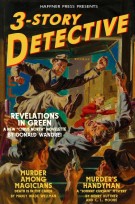
"Revelation in Green" 3-Story Detective, 2025
THE FIVE TOOTHLESS DRAGONS
Introducing Cyrus North, the scientific crime co-ordinator
By Donald Wandrei
Author of the “Ivy Frost” Novels

I.
RHODA KING wasn’t sleeping very well. She tossed and twisted uneasily. In the panel of moonlight that crept across the bed, the dark red mass of her hair looked black against the whiteness of the sheet. A faint wind, drifting through the open window, eddied the curtains so that the panel of moonlight shifted and swayed in a kind of eerie dance. It made her face seem to flicker.
The long lashes of her eyes trembled fitfully, but she did not waken. Her face, with the soft curve of lips and perfect profile, looked almost like that of a sleeping madonna, except for the tiny half moon of a scar under her left cheek bone. The scar was barely visible as a whiter line against the purity of her complexion.
The flaw, in a curious way, gave her face a strength of character. It endowed her with a positive, perilous quality, and put the seal of earth upon her beauty.
Rhoda King moved restlessly. She curled up like a kitten. She rolled ever and stretched flat on her stomach with arms outflung in the shape of a human X. She lay sidewise diagonally across the bed. She turned upon her back, and her breasts rose tautly and relaxed with her irregular breathing.
She had troubled dreams, nightmares in which terrifying creatures pursued her and fantastic deaths surrounded her. There was one vivid sequence concerning a labyrinth deep underground. She wandered endlessly while monsters and dragons howled prophecies of doom that reverberated down dark corridors lined with corpses which swayed upright in glass cabinets.
RHODA KING awakened. The wail of sirens rose and fell outside. Early morning light was streaming through the window. Fire engines clanged along the streets of Center City. Listening, she decided that they sped toward the business district.
She waited for them to stop. But they didn’t cease. The sirens shrilled up, from many different stations, rising and diminishing as the apparatus raced to the same goal.
Rhoda slid out of bed and went to the window. From her small apartment on the third floor of the Summit, she had a view of the entire downtown district where it sprawled in a bend of the Black Muddy River. She saw the huge “1” in red neon lights an top of the First National Bank Building, fifty stories high and the city’s tallest skyscraper. A redder glow spread up from another building a block nearer.
Rhoda King felt a sudden pressure on her heart as she stared at the conflagration. The twelve story Whitestone Building had caught fire. She saw the flames, the great clouds of black smoke, the silvery streams of water. She couldn’t believe her eyes, because the Whitestone Building was fireproof. Rhoda didn’t want to believe what she saw, because she had an office in that building, and her office lay at the core of the fire.
With swift, lithe ease, she slipped her pajamas off and dressed. Her body was as firm and supple as a dancer’s, five feet and five inches of provocative curves and interesting slopes and slim, flowing lines. Her legs could have sold a million pairs of hose or shoes if she had wanted to do photographic modeling.
The tailored gray tweed suit, by its extreme simplicity, brought out in striking contrast her cream white complexion, the deep blue of her eyes, the rich, dark red halo of her hair. She didn’t stop for a hat. She didn’t stop for make-up, or even to comb her locks. As she ran down the stairs, her hair, in half length, failing in ringlets upon hor shoulders, bobbed with a careless abandon.
With a little more wildness, Rhoda King would have been a nymph in flight, and with a little more preparation, she would have been the chic young débutante off to a fashion show or a cocktail party.
She slid behind the wheel of her blue coupé and drove it out from the parking court in back of the Summit. Rolling down Summit Hill, she lost sight of the fire, but she could still see the column of smoke rising above the intervening buildings. The banshee wail of sirens had finally ceased to rasp the ears.
Rhoda King couldn’t get within two blocks of the Whitestone Building. Half the fire equipment of Center City surrounded the building, while hose lines and big yellow trolleys, police radio patrols, and the cars of the curious blocked the streets adjacent. She parked the coupé and hurried as close to the scene as she could get.
The fury of the fire appalled her. From the third to the seventh floor, the offices for half the block-long west side of the building belched a red hot, almost a white hot inferno and black sea of smoke. Metal window frames melted, steel beams warped under the heat, and chunks of granite split off the exterior facing as the water hissed upon them. In the very center of the blaze, Rhoda’s office lay completely gutted.
She watched until the fire was brought under control, until the red heat died out, and helmeted figures climbed through the gaping windows. Two firemen prowled through the débris of her office. They brought something to the window, something that they wrapped in an oilskin.
Rhoda gasped, and a shiver of cold horror ran through her. She had caught a glimpse of a skull, bones, a skeleton human framework. Even the unimaginable intensity of the fire which utterly destroyed the rest of the corpse had not been able to consume the bones.
“Move on, lady; move on.” A uniformed officer jostled her.
Her thoughts dazed, she walked back to her coupé. She had an ominous, oppressive feeling of trouble ahead. The police would be inquisitive about the identity of the dead man, about the fire, and about Rhoda. They would flatly refuse to accept her statement of simple truth, “I can’t explain it.”
She drove back to her apartment, scarcely conscious of the howling sirens that again shrilled up. A ladder company raced past her, the two long sections of the truck rocking as they swung toward the steep hill. An engine and pump followed, streaking toward the hilltop.
For the second time that morning, Rhoda’s heart tightened. The trucks and apparatus halted at an apartment house on the bluff overlooking the business district. The new fire had broken out in the Summit. And it raged at its hottest in Rhoda’s own apartment.
She couldn’t conceive how a fire of such intensity had started and developed so far in the time that she had been gone, an hour and a half. It obviously had mushroomed out of her apartment, but she tried in vain to think of any way in which she had been careless. She hadn’t lighted a cigarette, or left the stove on, or a fire in the grate. But flames gutted the apartment as they had swept through her office.
She didn’t step out of the coupé. It was all that she had left. Sick at heart, she thought of her wardrobe, letters that she had saved, jewelry, heirlooms, books—everything she owned and loved, turned into ashes.
Yesterday she had drawn her last dollar out of the bank.
Numb, she stared while the fireman put the blaze out. And when the helmeted figures came dimly through the smoke, bearing a charred horror that had once been human, a body that they took from the wreckage of her own apartment, Rhoda clenched a hand to her lips to choke back a cry.
II.
IT couldn’t be. These things couldn’t happen. She lived alone, and she had left her apartment only a little more than an hour ago. A corpse could not possibly have been found there. But the firemen found it.
A dumpy housewife, talking to a policeman, began gesticulating and motioning excitedly as the body was carried out to an ambulance. She looked around, spied Rhoda and the coupé, and pointed. She screamed frantically. Rhoda couldn’t distinguish the words, but the cop started toward her, and two more men got out of a radio patrol car.
Rhoda pushed the starter and swung away from the curb. The cop blew his whistle. Rhoda turned at the nearest corner. The men from the squad car piled back into it and picked up the chase.
A wave of panic sent Rhoda fleeing. She ought to have waited for the police, she told herself. She ought to go to them now and tell her story. But there were two corpses whose presence she could not explain. She needed time, time to think, and above all, she needed help.
The city fathers of Center City had specified that all police cars must be snow-white, after a number of bad accidents had occurred. Thereafter motorists could identify a police car at a distance of blocks even by night and give it the right of way. The municipal Solomons belittled the fact that criminals could also distinguish the police cars a long way off. The radio squads had fewer accidents in speeding to objectives; but, oddly enough, the percentage of suspects and criminals who escaped was mounting.
Rhoda shook off the first prowl car. Two miles from the Summit, she stopped at a drugstore and went into a telephone booth. She dialed a number.
“Center Hotel,” said a suave, impersonal voice.
“Mr. Jonson; Warren Jonson, Room 1705,” said Rhoda. Through the glass of the booth, she watched the coupé.
She heard buzzing sounds, and after a minute, “Mr. Jonson does not answer.”
Rhoda insisted: “Will you please see if he left any message about where he can be reached or when he’ll return?”
There was another pause, then the words of finality: “Mr. Jonson’s key is at the desk. He has not been in all night. He left no message of any kind.”
Rhoda hung up and hurried out to the coupé. A white radio car was skimming down the street. She turned the corner, kept her eyes on the rear view mirror, and breathed a sigh of relief when the police car went by.
Driving southward, she crossed the Black Muddy River and swiftly covered the road that led to the stockyards in South Center City.
The radio began to talk. A hard, impersonal voice from Station PDCC said: “Watch for a 1938 blue coupé, license number 1,924,851. The driver is Rhoda King, dark red hair, blue eyes, five feet five, weight one hundred ten, twenty-three or twenty-four years old. She is wanted for questioning in connection with murder. The coroner’s preliminary report shows that the unidentified man, at first believed to have burned to death in the fire that destroyed the King girl’s apartment, was shot to death. Repeating the description—” The voice droned on with the same details.
RHODA sent the coupé skimming along at fifty. There was no branch off this road that followed a course between the river and the bluffs which lined it. The jurisdiction of the police extended to South Center City.
An unidentified man—shot to death in her apartment. The words pounded through her head. Some sinister web was spinning around her, and every minute that she fled, her own actions were making her appear more and more guilty in the eyes of the police.
The coupé swept past the stockyards. Here the road branched and Rhoda took a side street, swinging through the residential section of the town. She stopped for a red light. A white car rolled by. Her heart thumped as a blue clad figure leaned out of the window, scanning her license plates. The radio car abruptly stopped with brakes squealing and made a U-turn.
Rhoda didn’t wait for the lights. The coupé shot across the intersection and missed a truck by inches. The prowl car turned the corner and, with siren howling, took up the chase.
She looked at the gas marker, which dropped toward zero, while the speedometer flowed up to sixty, seventy, eighty. She came out on the street car tracks at the edge of South Center City, but the driver of the radio car paced her a half block behind like a relentless demon.
A trolley car, making the turn in the Y at the end of the line, completely blocked the street. Rhoda slammed her brakes on hard.
With screaming tires, the coupé decelerated. The prowl car cut down the gap. Rhoda gave the wheel a sharp twist, horn blaring steadily. The coupé mounted the curb and took to the sidewalk. Two men and a woman scrambled wildly aside. The coupé sailed down the sidewalk past the trolley and swerved back into the street.
For a moment Rhoda thought the rear would skid into the trolley car. There was a tearing grind, a jolt, and then the coupé straightened out on the State highway. The rear bumper bounced on the street. A blue clad figure came running around the side of the trolley as the coupé sped away. A heavy revolver glinted in the policeman’s hand and an explosive crack! brought out a starry fracture around a hole in the windshield.
Rhoda disappeared around a bend in the road as the cop fired again. The shot missed.
Her face was waxen in its pallor as she let the coupé lag into normal cruising speed. Her lips quivered. Yesterday she had operated a business of her own, a very peculiar business, but a profitable one. Now her business was wiped out, her apartment and belongings destroyed, her bank account exhausted. She was a fugitive, wanted on at least one murder charge. She had only the few dollars in her purse, and the coupé. She couldn’t even sell the car: she would only have possession of it for the few hours longer that it took the police to catch her and impound the car.
A sleek sedan swung out past her and suddenly wedged inward, forcing her to the roadside. Startled, she pushed the brake pedal hard. The sedan stopped beside her. A bull necked man with a cauliflower ear was driving it. A second man, with strangely hot hazel eyes and a nose that ended in a finger of flesh like the beak of a vulture, sprang out. He carried an automatic.
Until she saw the second man, Rhoda had thought that they were detectives who had commandeered a car.
The hook nosed man snarled: “Nick, keep the jellopy right behind us.”
“O. K., Johnny.”
Johnny climbed in beside Rhoda, jabbing the automatic into her side.
“Step on it,” he said harshly.
THE ashen color left Rhoda’s cheeks and the bloom of anger brought a hectic flush. The tiny scar on her left cheek turned crimson as it always did in moments of danger or tension. She drove slowly onward.
“Faster,” ordered Johnny. “Stick to thirty.”
Rhoda said evenly: “You’ve been following me since I left my apartment. Why?” She had been watching so intently for snow-white police cars that she had overlooked something equally obvious: the sedan trailing her, which had now caught up with her.
“I’ll do the talking,” said Johnny. The automatic bored into her side like a ring of fire. “Turn off at the next road, left. And don’t try any tricks.”
Rhoda watched the smooth concrete, looking for bulges, fissures, anything that might serve to jolt the car sufficiently to knock the pistol aside. But the road flowed on, unbroken. She saw a truck speeding toward her, and for a moment thought recklessly of trying to sideswipe the machine.
The truck sped by, traveling above forty. The automatic bored relentlessly into Rhoda’s side. She turned at the macadam road that wound away through hills. And behind her, never more than a dozen yards distant, the sleek sedan followed.
There was nothing soft about these men, no weakness that she could appeal to. They carried out orders and would only stop when her riddled body lay tossed into some lonely ravine.
The road climbed along the bluffs and hills. There was a narrow bridge ahead, spanning a stream that emptied into the Black Muddy. Between concrete posts at each end of the bridge stretched an iron guard rail.
Still traveling at thirty miles an hour, Rhoda gave the wheel a spin. The coupé smashed into the concrete post. Her feet on the pedals and her grip on the steering wheel cushioned the impact for her, but Johnny kept going.
Johnny gritted, “You damned little tramp,” and tightened his finger on the trigger. His head snapped forward and smote the windshield. Jerked out of position by the crash, the automatic blasted into the seat cushion. Flame scorched Rhoda’s side. Johnny slumped over, blood trickling from his forehead and nose.
Things happened fast. Rhoda snatched the automatic and swung the door open. The coupé dipped over the bridge. The concrete post, sheered off, toppled into the ravine. Rhoda jumped, sprawling to the highway. With a grinding scream, the guard rail tore loose. It spilled into the dropoff, seconds ahead of the coupé’s lunge. As she shakily got to her hands and knees, Rhoda saw the car carom off the embankment, turn over in mid-air, right itself, and plow crazily down the hillside to the stream fifty feet below.
The sedan slammed into a dead stop. Nick, for all his bulk, swung from the seat with a cat’s ease, his pistol spurting.
Rhoda scrambled behind a clump of willows and boulders. A slug whined off the stone and a splinter gashed her chin. The tiny half moon pulsed brightly on her cheek.
The crashing sounds ceased at the bottom of the valley. A man’s voice floated up, cursing furiously. Johnny had escaped from what should have been a fatal plunge.
Rhoda wasn’t getting a single break.
“Coming, Johnny!” bellowed Nick as he climbed and slid down the bank.
Rhoda dashed through the woods past the sedan. Nick had cut the ignition and taken the keys. She paused, aimed carefully, and shot at the two back tires. The hissing air sounded like twin Bronx cheers.
An angry yell burst from the ravine. Rhoda, a grim smile of satisfaction curving her lips, ran through the woods. For a while she heard noises of pursuit, but she ran as fleet footed as an athlete.
Half an hour later she came out on the main highway. The cut on her chin had stopped bleeding. Prickly ash and thorns had snagged her clothing. Her hose gaped at the knees, and the palms of her hands were scratched. With the wreck of the coupé and the loss of her purse, she was reduced to the things she wore, and an automatic containing three cartridges.
But Rhoda King had a dangerous gleam in her blue eyes and her lovely lips were set in stubborn determination.
A cattle truck rolled along the highway, heading toward the stock yards. Rhoda hailed it. The driver, a farmer with grizzled face and a reeking pipe, stopped. Rhoda swung into the cab.
“I reckon you’re the girl the city cops are huntin’ for,” said the driver with a tobacco stained grin, “Heard it over the radio when I was loadin’ up.”
Rhoda reached for the door handle.
“Hold your hosses,” drawled the farmer. “Ain’t none of my doin’s. ’Sides, you’re too purty to be mixed up in killin’s. If the city cops want you, let ’em catch you. Set still. I’ll take you far as I kin.”
Rhoda said: “I’d like to get into Center City, but there’s a police blockade. They’ll be looking for me, stopping all cars.”
The driver chuckled. “Waal, now ain’t that somethin’? We’ll fix you up.”
“How?”
“This seat, it’s all hollow underneath, Used to be a extry gas tank, but I took the blame thing out. You’ll fit in there nice and slick. I don’t guess the cops’ll be expectin’ you on a cattle truck.”
III.
THE International Testing Laboratory occupied an entire block on the water front of the Black Muddy River on the east side of Center City. It was a low building, two stories high, except at one corner where it threw up a ten story tower. Modern in design, it gleamed with chromium streamlines. The setting sun reflected redly on the panes of its hundreds of crystal windows.
Five o’clock drew near. The staff and the technical supervisors began to anticipate the closing gong.
In his private office, Cyrus North, director of the I. T. L., looked up as his secretary walked in. Not quite six feet tall, North had a lean hardness that contrasted with the nervous tension that always seemed to hang over him, the energy that flowed out of him. The lids drooped deceptively over his smoke gray eyes. There were dark circles under them, circles that sometimes made his eyes smolder like coals. They came, not from too much night life, but from staying all hours at the I. T. L. to work on difficult problems.
North ran a hand through his disheveled walnut brown hair. His hair was always disheveled. He wore a laboratory smock. An inchoate mass of correspondence, reports, pads, toy models, formulae, diagrams, and miscellaneous items by the dozen littered his desk. Yet, at a second’s notice, his hand would dive with unerring accuracy into that formless heap and extract whatever was needed.
His secretary handed him some papers. “These letters must be signed.”
Sarah Slocumbe watched him affix his signature after a rapid glance at each. Sarah was an incredibly homely woman with a lantern jaw, spectacles, gray hair, and a forbidding face of granite. She had a shrewd mind, a flair for details, and priceless efficiency.
There was a knock on the door and a short man with a pink baby face walked in. Werner-Smith, chief of the chemical division, said:
“Here’s the final report on the Atlantic Corporation’s casein wool and spun glass fabrics. Also the data on those bones from the Whitestone Building fire.” He placed an assortment of human bones on the desk and went out.
The telephone rang.
“Yes,” said North, waving a hand for Miss Slocumbe to wait.
She stood by the door.
“London calling,” said the operator, and after a moment, “here’s your party.”
A different voice said: “Empire Rubber Products, Limited. Can you complete the testing of our new Compo-plastic Process Tire within twenty-four hours? There is urgent need of the analysis. A large order relating to the national defense rearmament program depends upon the report.”
“The report will go out tomorrow afternoon,” said North and hung up.
Sarah Slocumbe frowned disapprovingly. “That means you’ll be here all night again to rush the work through.”
North shrugged. He resumed construction of a small scale model with which he had been engrossed when interrupted.
Sarah looked at a memo sheet in her hand and said: “Dean Winson of the Women’s Academy called and wanted you to give an address next Friday on ‘The Career Woman’s Place In Industry.’ I told her that your broken rib would make it impossible for you to speak.”
“Good,” North approved, and then glanced up, startled. “A broken rib? Use more imagination if she calls again. Tell her I’ve got pernicious anemia or jaundice. They’re good for several months.” He bent over the model again.
Sarah continued: “Mr. Kenwald, the lumber king, has raised his offer from five thousand to ten thousand dollars if you will investigate the disappearance of his wife’s diamond collection.”
“Tell him to buy her a new collection.”
“The South Side Boys’ Club asks you to judge a model seaplane contest.”
“Nuisance,” said North. “I’ll do it.”
“I’ve already accepted the invitation for you,” Sarah declared tartly. “The Junior League wants you on the reception committee of the next charity ball. I replied that your broken toe would make it impossible for you to attend.”
“You fracture me at an alarming rate,” said North.
“A Chicago insurance company offers to let you name your own fee for establishing definitely whether a million dollar policyholder was murdered or committed suicide. I declined on your behalf. A Mrs. Racciola sent an incoherent letter. She is very poor. Her son has received a life sentence for murder. She claims that he was framed, that the selenium powder was stolen from him and—”
“Selenium powder?” North repeated. “That’s a highly unusual poison. Arrange an appointment with her tomorrow. I’ll look into it.”
“Mayor Hogan requests your support in the coming election. A notice posted where all the employees can read it—”
“Prepare a bulletin concerning Mayor Hogan. Say that he is an incompetent and blundering fool unfit to hold any higher political office than assistant street cleaner.”
THE door opened without warning. Coroner Randall and Police Chief Gunnar tramped in.
“That will be all,” North dismissed Sarah Slocumbe.
Randall was a dour, dyspeptic looking man, half bald, and dressed in funereal black. A black silk ribbon ran from a vest button to the pince-nez perched on his nose. Police Chief Gunnar, a big, slow moving Swede, had banana yellow hair and around, placid, bovine face.
“Er-rh—about those bones,” Randall began in a reedy twang.
“Wait a minute.” North made a delicate adjustment on the mechanical model.
“What kind of a toy is that?” Gunnar asked, putting a fat black cigar into his mouth and chewing it slowly.
“It isn’t a toy. It’s a scale model for a new microscope and camera. We need a microscope that will enlarge by one hundred thousand diameters and a camera that will take pictures at one millionth of a second. Photomicrography of that power is essential for some of our research.” North carefully put the model aside and picked up the array of bones together with the report that Werner- Smith had left.
North said: “There’s no evidence of murder, but the finding is inconclusive: The intense heat to which the body was subjected destroyed all fleshy parts. The subject could have been asphyxiated, poisoned, stabbed, or killed in a variety of other ways, without a shred of proof being found in the skeleton.”
Gunnar grunted, without removing his cigar. “We’ve figured out how that fire—”
North nodded impatiently. “I know; thermite was used and generated the high temperatures that melted steel and split stone.”
“We got a warrant for Rhoda King,” Gunnar rumbled. “She took it on the lam out of town, but it won’t last long. We’ll get a confession and have her make the identification soon as we pick her up.
“The way she worked it was like this. A week ago, through an agent, she rented the office above hers. Three days ago she banked two thousand dollars. Yesterday she cleaned her account out—a little over three thousand in cash. We figure she took the two thousand from this dead guy. By the way, you didn’t say if it was a man or woman’s bones.”
“Man,” said North.
“Well, she took his two thousand, and then killed him for some reason, left the body in her office, and set a fuse to touch off the thermite upstairs after hours. The stuff burned through the floor before anybody even noticed the fire. It gutted her office and went through another floor where a lot of paint and varnish was stored. That’s the trouble with these fireproof buildings. They may be fireproof, but the stuff that’s in ’em ain’t.
“Then she started the fire in her own apartment, where she had killed this second guy, and skipped out. Only she didn’t do such a good job the second time. We identified that body through dental work. It’s a fellow named Jonson, Warren Jenson, that she used to go with some. She plugged him right smack through the heart.”
NORTH leaned back and ran both hands through his hair “That’s a very interesting theory,” he drawled, “but it overlooks one small point. Rhoda King couldn’t have got two thousand dollars from the man in her office and she didn’t kill him.”
“What’s that?” twanged Coroner Randall.
“The bones are those of a man who has been dead at least a year,” North stated.$
Randall’s jaw dropped. “A year, did you say a year?”
“Bones are living matter, like flesh and blood. Their vitality ends with death, as you know,” said North. “These bones show traces of formaldehyde as well. If Rhoda King killed a man, pickled the corpse, and kept it around her office for a year, she either has a very peculiar sense of humor or an inhuman flair for the gruesome. Furthermore, these bones are not those of an American or even a white man. They belong to a Mexican or Central American Indian.”
Gunnar, dumfounded, flopped his big bulk into a chair.
“That’s fine,” he said morosely. “What the devil would a Central American Indian be doing up here?”
“That’s for your staff of bloodhounds to find out.”
The police chief scowled. “You know damn well the city doesn’t give us enough money to hire good men or even to have our own lab. That’s why we come here when we need science stuff. You’ve got the equipment, the experts. You could look into this case.”
North shook his head firmly. “I’m too busy. I haven’t time to go through every murder that happens. I’m only interested in the unusual ones, and then it’s a hobby with me, not a profession.”
“Now look,” Gunnar complained. “You solved that killing up on the international border last summer. The papers called it ‘The Case of the Flying Corpse.’ Remember?”
“I was on vacation,” said North. “I had to do something to amuse myself.”
“And there was that mess in Hennepin County. ‘Red Water and Blue Death.’ ”
“I happen to be there on business.”
Gunnar counted another finger. “Then you solved the murder of the Elmore twins in that crazy affair. ‘The Stone Age Killings.’ ”
“A friend of mine knew them and dragged me in.”
“And you cleaned up the weird case about ‘The Stolen Worms.’ ”
“Circumstances forced me,” said North. “The stolen worms belonged to the I. T. L.”
Gunnar closed his fist. “Then ‘Three Boiled Eyes’ came along, and ‘Kangaroos from Canada,’ and the one about ‘The Bleeding Dolls,’ and the—”
North cut in, “I’ll appoint you my official biographer.”
Gunnar jerked the soggy cigar out of his mouth. “Listen, North. You’ve handled a dozen tough cases. What’s your objection to this one?”
“I haven’t time. I’ve got to rush some tests through for an English corporation tonight.”
Gunnar sighed. “Maybe this’ll interest you more. The second body, the Warren Jonson that got killed in Rhoda King’s apartment—now, now, I’m not saying she killed him, just that that’s where we found the corpse—well, this Warren Jonson had a hundred and sixty-seven teeth.”
“What!” exclaimed North. He suddenly leaned forward, and his smoke gray eyes became animated. He added, with a sardonic drawl, “One hundred and sixty-seven teeth? Amazing. I was not aware that nature had ever endowed a human being with such an ample supply of ivories. Mr. Jonson’s grin, while he lived, must have been a magnificent display of toothiness.”
Gunnar shook his head in mild reproof. “I didn’t mean it that way. He had a hundred and sixty-seven teeth all right, but he kept them in his pockets.”
“He carried a hundred and sixty-seven teeth in his pockets? Why?”
“That,” said Gunnar succinctly, “is what I want you to tell me.”
“Jonson, I take it, did not have false teeth, and the extra teeth were not duplicate sets for special use or for emergencies?”
“Right.” Gunnar cut off the wet end of the cigar and pushed the remaining stump back to his mouth. “He had his own teeth, all right, a full set of them. But he carried these hundred and sixty-seven extras.”
He pulled a small package out of his pocket, opened it, and spread the contents on the table.
NORTH stared at the array of teeth that tumbled out. They made dry, clacking sounds, like dice rolling. He pushed a finger through the heap, leveling it off. After a minute of intensive scrutiny, he remarked:
“There’s a peculiar thing about them.”
“What’s peculiar?” demanded Coroner Randall, squinting through the pince-nez.
“The fact that there’s nothing peculiar about them.”
Gunnar tore the cigar out of his mouth. “I don’t feel in the mood for riddles. Are they or aren’t they? Yes or no? That stuff about they’re different only they ain’t different, the hell with it.”
North retorted: “Your eyes are as good as mine. Look at these teeth carefully. There are children’s teeth and adults’ teeth. I see molars and bicuspids, cuspids and incisors. Approximately half of the teeth are perfect. The others show abscesses, dental caries, and fissures. There are a number of fillings—silver amalgam, porcelain, gold, and cement. In other words, these teeth are of all kinds, shapes, ages, and conditions.”
“Sure, that is plain,” growled Gunnar.
“And that’s what is peculiar about them,” said North, “Human beings have queer hobbies. People have collected all sorts of strange objects ranging from paper match containers to stamps, from old whisky bottles to butterflies and string and autographs. I’ve never heard of anyone collecting teeth, but if Jonson had pursued so queer a hobby, he would have had a selective principle. He would have specialized in molars, or perfect teeth, or bad teeth, or teeth with unusual fillings. But this pile is just a haphazard array, the sort of accumulation that you might find in any dentist’s office. Therefore, Jonson did not collect teeth for a hobby.”
“But he had ’em just the same,” insisted Gunnar.
North looked pained. “A second deduction would be that Jonson was a dentist, had kept the teeth he extracted, and for some odd reason carried them in his pocket the night he was murdered. But since Jonson was not a dentist—”
“How do you know?” demanded Gunnar. “I didn’t say he wasn’t a dentist.”
North said impatiently: “If Jonson had been a dentist, and led a double life, with a side line of crime, he wouldn’t have kept the teeth in his pocket. They would be telltale evidence. If he wasn’t a dentist— Oh, forget it. I haven’t time to go into long explanations. I state it as a simple fact that Jonson is not and has never been a dentist.”
Gunnar shook his head. “It’s by me. You haven’t seen the body. Far as I know, you never met him. You’re right. Jonson wasn’t a dentist.”
“A third deduction would be that the one hundred and sixty-seven teeth have no significance whatever.”
“Then why did he keep them in his pockets?”
North glanced at the clock. “A red herring. The murderer might have stuffed the teeth into Jonson’s pockets in order to sidetrack the police.”
Randall grew plaintive. “You’re telling us what the teeth don’t mean. That’s no help. What we want to know is this. Just what do they mean? Why did Warren Jonson have a hundred and sixty-seven teeth in his pockets when he got killed?”
North stood up. “That’s your problem. I’ve eliminated three reasons. The list is so narrowed that you can easily proceed.”
“Wait a minute,” Gunnar began.
“I’m busy,” North interrupted. “I’ve got a full night’s work ahead.”
Gunnar tossed the soggy cigar butt into an ash tray and scooped up the display of teeth. “Just the same, we’re going to pin the Jonson murder on that King skirt even if she does slide out of the other one. Sure as hell, she’s guilty or she wouldn’t have set those two fires. Come on, Randall; we’re shoving off.”
“Why don’t you look into the Chinese situation?” North remarked in an offhand manner.
“Er-rh—what’s that—what’s that you said? The Chinese situation?” twanged Randall.
North bent over the model on his desk. Randall and Gunnar eyed him suspiciously for an instant, then stalked out.
IV.
CYRUS NORTH, his attention absorbed by the model for the new photomicrographic machine, was vaguely conscious of the five o’clock gong. A few minutes later, the office door opened and shut.
“I’ll be through in a little while,” North said without looking up. “Wait till I finish this adjustment, Sarah.”
Footsteps crossed the room. “I can’t wait. The police are hunting for me. Some killers are after me. If they learn where I am, they’ll follow me even here. You’re the only person in Center City who can help me now. You must help me, you must listen!” The voice, urgent, almost fiercely breathless, had a vibrance that doubled its contralto.
North snapped his head up. The girl looked more determined and angry than frightened. A strip of adhesive covered a cut on her chin. The fiery blue in her eyes and the excitement on her face were matched by the tiny scar that nestled below her left cheek bone, like a half circlet of flame.
“You’re Rhoda King,” North mused. “I ought to give Sarah a stern lecture for letting you burst in.”
The girl was silent, breathing regularly with an effort, until the tension had gone out of her voice, She sounded cool and a trace of disappointment was in her voice when she spoke. “Your secretary is a good judge of character. But she seems to have made a mistake when she said that you would be interested in what I’ve gone through the past few days. I know it’s fantastic, but ever since I bought that corpse—”
“You what?” exclaimed North.
“I bought a corpse for two hundred dollars and sold it for two thousand, but the man who was to take it away didn’t come and now I’m caught in a trap. I’ll be killed if I keep out of the hands of the police, and I’ll very likely go to prison if I give myself up. The five dragons were destroyed in the fire at my office and left me penniless. I not only can’t hire a good lawyer, I don’t even have enough money to buy more clothes and I’ve walked eight miles to see you and—”
North interrupted her. “Sit down.” He turned to the interoffice communicator and spoke swiftly: “Sarah? Find out if Werner-Smith or Marlow of the chemistry division, or Atkins of engineering, have left yet. If they’ve gone, phone their homes and have them call back. I want whichever one is most available to finish the testing of that Empire Rubber Products tire. That’s all. Leave as soon as you’ve made arrangements.”
North looked at Rhoda King. She had a pleasant voice, a voice of training and education. But she had regained her poise and now her face was like a mask in its detachment.
“Start at the beginning,” said North. “You’ve mentioned corpses and dragons. Forget them. Let them come in their proper place. I want the story from the very start.”
“Fair enough,” Rhoda agreed. “I’m practically a stranger here. I’ve been away at college taking postgraduate work until two months ago. I was self-supporting. My father died several years ago and my mother married again, but my stepfather and I didn’t get along very well.
“About six months ago, mother wrote that Harvey, my stepfather, had gone to China on a business trip and had taken fatally ill and died there. She wanted me to come home, and I promised to visit her at the end of the school year. Two months ago I received a telegram saying that she was dying.
“Naturally I gave up my studies, packed everything I had, and came home immediately. She died the day after I arrived. For a week I lived in the three room apartment that she and Harvey had taken, but it depressed me so greatly that I took an apartment of my own at the Summit. Mother’s things I brought with me, Harvey’s I put in storage.
“There had been very little money, I needed a job, but I decided to try a business venture of my own, I rented an office in the Whitestone Building and put everything I had into launching the Service Bureau.”
North asked, “What kind of service bureau?”
“Every kind,” said Rhode. “I supplied service for anything, anywhere, any legitimate purpose. It was more fun than work and it began to grow quite profitable. For example, a man came to me one day with a request for an old-fashioned high wheel bicycle.”
“Did you locate one?”
“The same day. I found it in a back room of a pawnshop. On another occasion, I took care of two little girls from South Africa whose family, through a mixup, weren’t at the station to meet them. A hostess who suddenly decided to serve Scotch pheasant at a dinner she was giving in four days appealed to me. I wired to New York and succeeded in delivering the birds by air express in time for the dinner.
“Another time I was asked to provide a motion picture film produced any time before 1907. A wealthy man wanted it as a novelty for a private party that very night. The local film exchanges couldn’t supply it. I didn’t have time to order it from Chicago or Hollywood. I went to the oldest fireproof storage warehouse here, looked through its stock of unpaid, unclaimed, and unsold articles, and found several two reel features of the 1900 to 1910 vintage. Though in poor condition, they served the purpose.”
“That was resourceful,” said North. He eyed her with an air of approval.
“Center City, in a population area of over a million, demanded enough services to keep me busy. A month ago I received a shock. The papers carried a cable saying that Harvey had died in Shanghai of yellow fever and wounds. The previous report of his death had been a blunder.
“Two weeks later, a letter came from China, in my stepfather’s handwriting, addressed to my mother. It was a very short letter. It said that he had been severely ill at Nanking when the Japanese took the city, but he recovered sufficiently to make his way to Shanghai. He brought with him a treasure and he wanted mother to have it. He knew he was dying, and would never board ship, and mother had no money with which to pay the customs duties on the shipment. He said he had partially disguised it and shipped it to the mutual friend who had handled these deals before and who would get in touch with her.
“He must have been delirious, or afraid of censor trouble, because of the vague way he wrote. I had no idea who this mutual friend could be. I had left forwarding instructions for both mail and telephone calls at mother’s and Harvey’s apartment, but I heard nothing more about Harvey’s shipment.
“I went to the customs office, where I didn’t get a bit of information. The agent said that Center City was the port of entry for five States, and that tons of goods from the Orient passed through the customs every time a ship docked on the west coast. I thought that Harvey might possibly have sent the shipment addressed to mother but in care of the friend he had mentioned. The agent couldn’t find any such record.
“Next I searched mother’s belongings. I found no names at all, nothing to indicate who her friends or mutual acquaintances with Harvey had been. I made inquiries. I even asked casual questions of the clients who came to my office, without result. Mother and Harvey had evidently led a very secluded life.”
Rhoda paused as Sarah came in dressed to leave. Sarah said: “Werner-Smith was just going out to dinner. He’ll be back at seven and finish the Empire tire tests.”
North nodded absent-mindedly. Sarah marched out.
Rhoda continued: “A week ago an unpleasant looking thin man came to me. He had feverish hazel eyes, and a nose that ended in a fleshy hook, like a buzzard’s beak. He glanced around the office, made sure we were alone, sat down, and said, ‘I want to buy a corpse.’
“He spoke so naturally that I thought I had misunderstood him. I asked him to repeat it, and he said again, ‘I want to buy a corpse.’
“I asked him who he was. He hesitated before replying, ‘John Revo.’
“His request left me completely bewildered. I asked rather foolishly. “What kind of corpse do you want? Male or female?’
“He shrugged. ‘It doesn’t matter much.’
“I asked him, ‘What about race or color?’
“He said that they didn’t matter either.
“I wanted to know if he preferred youth, maturity, or age, and again he seemed indifferent.
“He finally said: ‘I only want to buy a corpse, preferably a full grown male, though the specifications aren’t important, except that it must be in a good state of preservation.’
“His cold-blooded attitude, as if he were buying a slab of meat, gave me chills. But he had roused my curiosity. I demanded his occupation, and what he intended to do with the corpse.
“He answered: ‘I’m a self-taught expert in animal biology. I don’t have a doctor’s degree or license, and I’m not connected with a recognized school. But I’ve made a discovery that revitalizes dead tissue. It works on the lower animals. If it works on dead human tissue, it will be of great value in preserving live cells, preventing their decay, and treating the diseases of age.’
“He went on to say: ‘It’s impossible for me to get a corpse through legitimate channels. I have money, but obviously I’m not going to loot a graveyard or kill somebody, no matter how badly I want a corpse. I don’t care to get mixed up in crime. I’ll pay up to two thousand dollars for a good sound corpse.’ ”
V.
RHODA stopped and eyed a box on North’s desk. He opened it and offered her a cigarette. She lighted it, but after one puff toyed with it and let the smoke plume eddy.
“His story sounded both right and wrong,” Rhoda went on, “and Revo himself, in spite of what he said, looked like the sort of man I’d hate to meet in a lonely spot at night. But two thousand dollars was a large sum to me. However, I had no idea how to go about buying a corpse, or what it would cost. I told Revo to come back in a couple of days.
“I first went to the medical school at City College. The attendant told me that it would be impossible for him to sell me a corpse, that it would cost him his job if he did so. The corpses, tagged and numbered, hung erect on hooks in a huge, glass walled vat, filled, I suppose, with alcohol or formaldehyde or some such fluid. I lost my appetite for the job right there, and I very nearly lost some other things as well.
“The attendant told me that a daily census of the corpses was taken, partly because medical students are apt to play grisly pranks with the material that they work with. Much as he would like to help me, he said there was nothing he could do.
“Then I asked him where the school got its supply of cadavers. I learned that they came entirely from three sources. Occasionally a corpse would be inherited from someone who had specified in his will that his body should be used for medical research. The city morgue furnished the second and largest group. There were the corpses of unknown and unidentified persons, given to the school when six months passed with out a claimant. The third source was outright purchase.
“I asked the attendant, ‘Do you mean that you actually buy corpses?’
“He looked surprised. ‘Sure we do. We can’t always depend on a steady supply coming in more or less by accident, Anyway, the school sometimes wants special kinds of cadavers, like freaks, and it buys them when they’re available.’
“I asked him who made a business of selling cadavers, and he told me: ‘A firm called Anatomical Specimens. Its main office is in New York, but it has a branch in Chicago and another here.’
“I wanted to know where the firm got its supplies.
“The attendant said, ‘Nobody knows, and nobody asks.’
“Then I inquired, ‘How much do you pay for the cadavers?’ He told me the usual price was one hundred and twenty-five dollars, and gave me the address of the company.”
Rhoda tamped her cigarette out. Dusk had crept into the room and North silently turned on a desk light.
Rhoda continued: “I went to Anatomical Specimens, where I got much additional information about the gruesome trade of buying and selling corpses. I stated my purpose, showed my business credentials, and explained that it was absolutely necessary to keep the names of my clients confidential. After a few skirmishes, I made arrangements to buy a corpse for two hundred dollars. I knew that this was at least fifty per cent higher than the usual price, but accepted because of the irregular nature of the deal. The sum bought me the adult corpse, male, in good condition, of a Mexican Indian.
“Two days later, John Revo returned. He repeated his offer and when I informed him of my success, he promptly brought out a big pack of bills and paid me two thousand dollars. I asked him where he wanted the cadaver delivered. He insisted that I keep it at my office for a day or two, ready for instant delivery when he notified me. I demurred, and we had a hot argument before I finally agreed to his terms.
“I then made the payment to Anatomical Specimens, and next day received a big, rectangular crate which the movers placed upright in a corner so that it somewhat resembled a filing cabinet. I didn’t open it.
“The same day, another client came to me, a man who had given me commissions when I first opened the office, and whom I had seen several times. His name was Warren Jonson. He offered to sell me five dragons for three thousand dollars plus shipping costs. I instantly thought of my stepfather’s letter, for Jonson admitted that the five dragons were carved of jade and originally came from China. I demanded to see the dragons, but Jonson was evasive. He refused to tell me how he got them, or to take me to see them. However, he agreed to send them to my office on approval, and told me to have an art dealer or museum official appraise them.
“When the five dragons arrived. I studied them thoroughly. Each was about two feet long, and finely carved out of solid jade. I knew nothing about jade, but the dragons looked of better quality, and the color seemed more distinctive than other jade I had seen. However, they all had a flaw: the teeth were missing. I could plainly see the mountings where the teeth had once been inset. I became excited, for I jumped to the conclusion that these five dragons formed part or all of the missing shipment that Harvey had sent to my mother.
“The art dealer whom I called in to appraise them beat around the bush. He talked about Ming and Manchu and periods and dynasties that meant nothing to me. He said that the dragons would be worth a thousand or fifteen hundred dollars each except for the flaw, the missing teeth. He offered me thirty-five hundred dollars for the lot, and said the offer would be good whenever I decided to sell. I figured that I couldn’t lose by buying them from Jonson, and would net a few hundred dollars if I sold them. I didn’t make any definite promises to the dealer.
“When Jonson came back, I bought the dragons from him. He insisted upon cash. The sum, a little over three thousand dollars, cleaned out my bank account. I questioned Jonson at length about the origin of the dragons, and why he used me as a broker, instead of selling directly to art dealers or collectors. He refused to talk. My suspicions about the dragons became confirmed in my own mind.
“I decided to investigate further, but I didn’t get a chance. Last night fire destroyed my office. It completely ruined the jade dragons. They became worthless junk. The fire not only wiped me out, it left me owing Revo two thousand dollars for the corpse I had promised to deliver. The cadaver itself was reduced to bones, and I found the police on my trail.
“I became frightened. If there had been anything illegal in my transaction with Anatomical Specimens, the man in charge might deny that I had bought the corpse. There had been no witnesses. I could prove nothing. I drove home. My apartment was in flames and the firemen brought the body of a man from the débris. I grew panic-stricken and fled. I escaped from the police. Once I stopped to phone Warren Jonson. He could explain the presence of the jade chips and splinters in my office, which would corroborate my story. I couldn’t get an answer. When 1 passed outside of the city limits, two men in a car forced me off the road.
“One of them was John Revo, the man who wanted to buy a corpse. He climbed in and made me drive on while the second man followed us in the other car. They intended to kill me, but I wrecked my car and escaped.
“I have no friends here, no money, nothing to fight back with now. The police have already decided I’m guilty of one or two murders. John Revo and Nick are out to kill me if I avoid the police. You’re the only one who can help me.”
[To be continued . . .]
Copyright © 1938 Street & Smith Publications, Inc. Renewed 1966 by Donald Wandrei. All Rights Reserved.